
TL;DR
Male pattern baldness affects about 25% of men before age 21, and more than half of men over 50 experience some hair loss. The key to better outcomes is catching it early. Warning signs include a receding hairline, visible crown thinning, a widening part line, and losing more than 150 hairs daily. The optimal window for treatment intervention is Stage 2 – once you notice progressive thinning over a 3-month period, it’s worth scheduling a consultation. Treatments range from prescription medications to regenerative therapies, and the earlier you act, the more options are available to you.
Recognise the early warning signs of male hair thinning and learn when it’s time to seek professional help in Brisbane or Gold Coast. From receding hairlines to crown thinning, here’s what you need to know.
Early Signs of Hair Thinning: What to Watch For
Hair thinning doesn’t arrive as a sudden announcement. It’s usually gradual, which is why many men miss the early warnings until the loss becomes obvious to others. By then, the intervention window has narrowed.
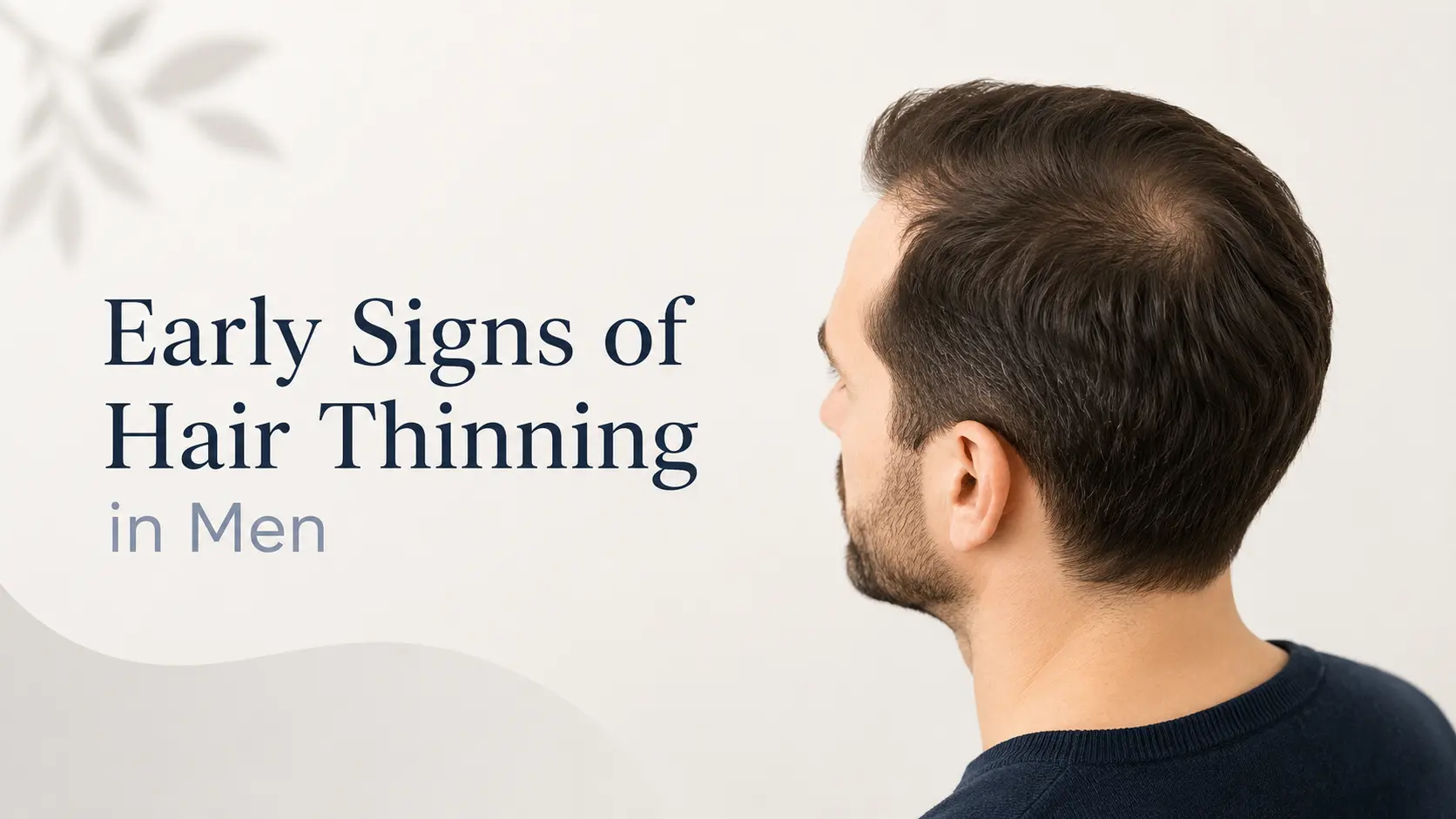
The first step is recognizing what early hair thinning actually looks like. Hair loss typically begins at the hairline or crown, progressing in a predictable pattern.
The Receding Hairline
This is often the first sign. The hairline pulls back, starting at the temples, forming an M-shape, U-shape, or widow’s peak. The shift is subtle at first, so you should compare photos from 6 months ago. In natural light, you might notice the hairline has drifted back slightly from where it used to be. This is your signal to pay closer attention.
Crown or Vertex Thinning
For others, thinning starts at the crown – a patch at the top of the head where the scalp becomes visible, especially when wet or under bright light. This can be harder to spot in the mirror, so look in photos taken from above or ask a trusted person to be honest about what they see.
Widening Part Line
If you part your hair, the part itself may become more prominent. The scalp becomes more visible along the line, or the part appears wider than it used to. It’s a subtle change, but noticeable if you’re paying attention.
Hair in the Shower and on Your Pillow
Losing 50 to 100 hairs daily is normal. But if you’re consistently finding more than 150 hairs, or seeing handfuls come out with gentle pressure, that’s worth noting. Track it for a few weeks to see if this is a one-time spike from stress or a consistent pattern.
Texture and Density Changes
Hair may become finer, weaker, less lustrous. Individual strands feel shorter, more fragile, breaking more easily. Your ponytail, if you keep one, is noticeably thinner than it was a year ago. Your hair feels lighter overall.
The Visible Scalp Test
Look at your scalp under bright light with your hair wet. Is scalp showing through in areas where it didn’t used to? Does it look less dense than photos from a year or two ago?
Why Timing Matters: The Intervention Window
Hair loss typically accelerates between the late teenage years and age 40–50. The earlier you notice it and take action, the better your outcomes.
The 3-Month Threshold
If you’ve observed progressive thinning or recession over a 3-month period, this is when it’s worth scheduling a consultation. You don’t need to wait for obvious baldness – early intervention is genuinely more effective.
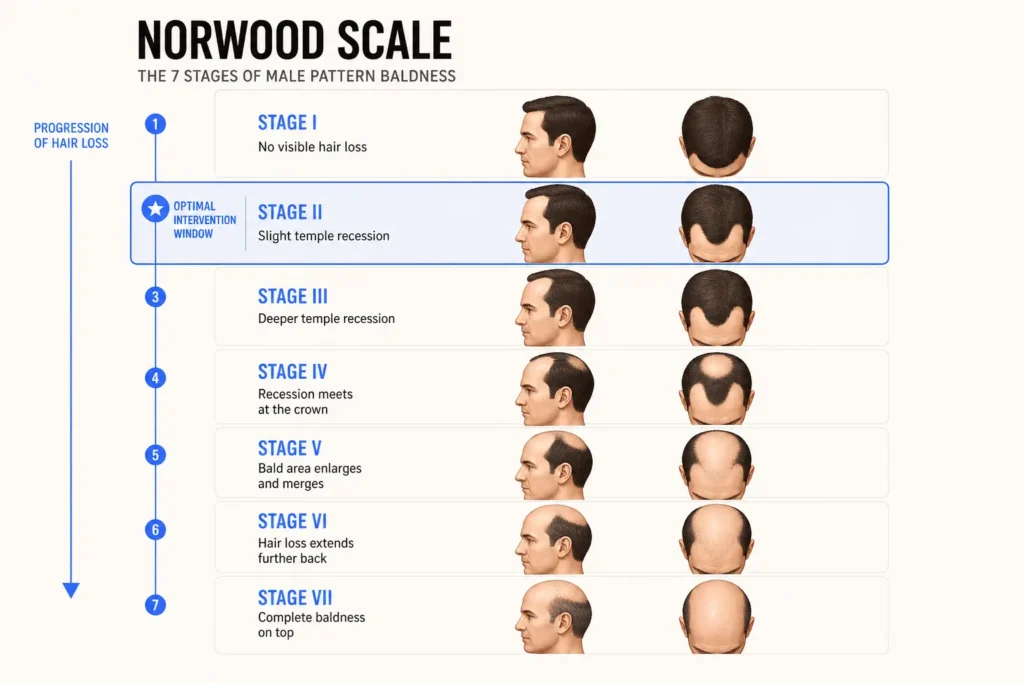
Here’s why: the Norwood Scale classifies male pattern baldness in stages I through VII. Stage 2, slight temple recession, the very first official sign is considered the ideal intervention point. At this stage, medications and regenerative therapies show the strongest response. Once you reach more advanced stages, your options narrow and the outcomes become less predictable.
The Cost of Waiting
Treatments are most effective when follicles are in early thinning stages and still responsive. Waiting doesn’t give you more information. It just means your follicles have miniaturized further, and you’re starting from a weaker position. Early intervention slows or halts progression, preserves donor hair for future options, and typically yields significantly better long-term results.
Understanding the Cause: It’s Not Just DHT
Male pattern baldness is triggered by genes inherited from either parent, combined with follicle sensitivity to DHT. But genetics isn’t the whole story.
Hair thinning can also stem from stress-triggered hair loss (telogen effluvium), nutritional deficiencies in protein or iron, thyroid dysfunction, or medication side effects. This is exactly why a professional assessment matters – a dermatologist or trichologist can identify whether you’re dealing with male pattern baldness, an underlying health condition, or a combination of factors.
What to Expect in a Consultation
When you see a specialist in Brisbane or Gold Coast, they’ll take a detailed history: when the loss started, how fast it’s progressed, family history, any medical conditions or medications, diet and stress levels. They’ll perform a visual inspection, possibly a pull test, and may order blood work to rule out thyroid or nutritional issues.
The goal isn’t to hand you a diagnosis over the phone – it’s to understand your unique situation and discuss realistic options. A good consultation is honest about what treatments can deliver and how long they take to work.
Your Treatment Options
Treatment isn’t one-size-fits-all. Options range from prescription medications to regenerative therapies, and the best approach depends on your age, the stage of loss, your lifestyle, and your goals.
FDA-Approved Medications
Minoxidil (Rogaine) is an over-the-counter topical treatment that may stimulate follicles and improve blood flow, taking at least 6 months of consistent use to show results. Cost is typically $15–$50 per month, and results require ongoing use to maintain.
Finasteride (Propecia) is an oral prescription that blocks 5-alpha-reductase, reducing DHT levels, with effects becoming apparent after 3–6 months. Cost ranges from $20–$75 monthly, and like minoxidil, it requires ongoing use to sustain results.
Regenerative Therapies
PRP (platelet-rich plasma) uses blood-derived growth factors injected into the scalp to stimulate follicles, typically requiring 3-6 monthly sessions initially. Results take 3-6 months and cost $400-$1,000 per session.
PRF (platelet-rich fibrin) is an evolution of PRP with a slower centrifugation process, creating a fibrin matrix rich in platelets and growth factors. This may provide more sustained release of growth factors, typically requiring 3-4 sessions spaced 4-6 weeks apart, at $600-$2,000 per session.
PRF Pro is an advanced formulation designed for optimal regenerative outcome, with emerging evidence and costs typically higher than standard PRF.
Complementary Approaches
LED (low-level laser therapy) is FDA-approved and uses specific light wavelengths to stimulate follicles, typically 2–3 times weekly with results appearing after 3–6 months. Cost ranges from $100–$300 per in-clinic session.
Microneedling creates controlled micro-injuries to trigger a healing response and improve absorption of topical treatments, often used monthly or every 4–6 weeks at $200–$600 per session. Many men combine microneedling with PRP or PRF for enhanced results.
Try Cosmed HairSkin Solutions
If you’re noticing early signs of hair thinning in Brisbane or Gold Coast, Cosmed HairSkin Solutions specializes in personalized, non-surgical hair treatments including PRP, PRF, and PRF Pro. The team includes Australian doctors, certified trichologists and experienced practitioners who assess your scalp health, identify the root cause of your thinning, and recommend a treatment plan tailored to your situation.
Rather than a one-size-fits-all approach, Cosmed focuses on understanding your scalp environment and follicle health, the foundation of any effective hair treatment. We offer free AI scalp analysis to give you concrete data about what’s happening beneath the surface, plus consultations to discuss realistic timelines and outcomes.
Whether you’re in the early stages of noticing changes or ready to take action, a consultation at Cosmed can clarify what’s happening and what your options actually are.
Individual results may vary. A consultation is required to assess suitability for any treatment plan.




 +61 406 888 546
 admin@cosmedhairskin.com.au
 Brisbane Bowen Hills: 10/7 O'Connell Tce, Bowen Hills QLD 4006