
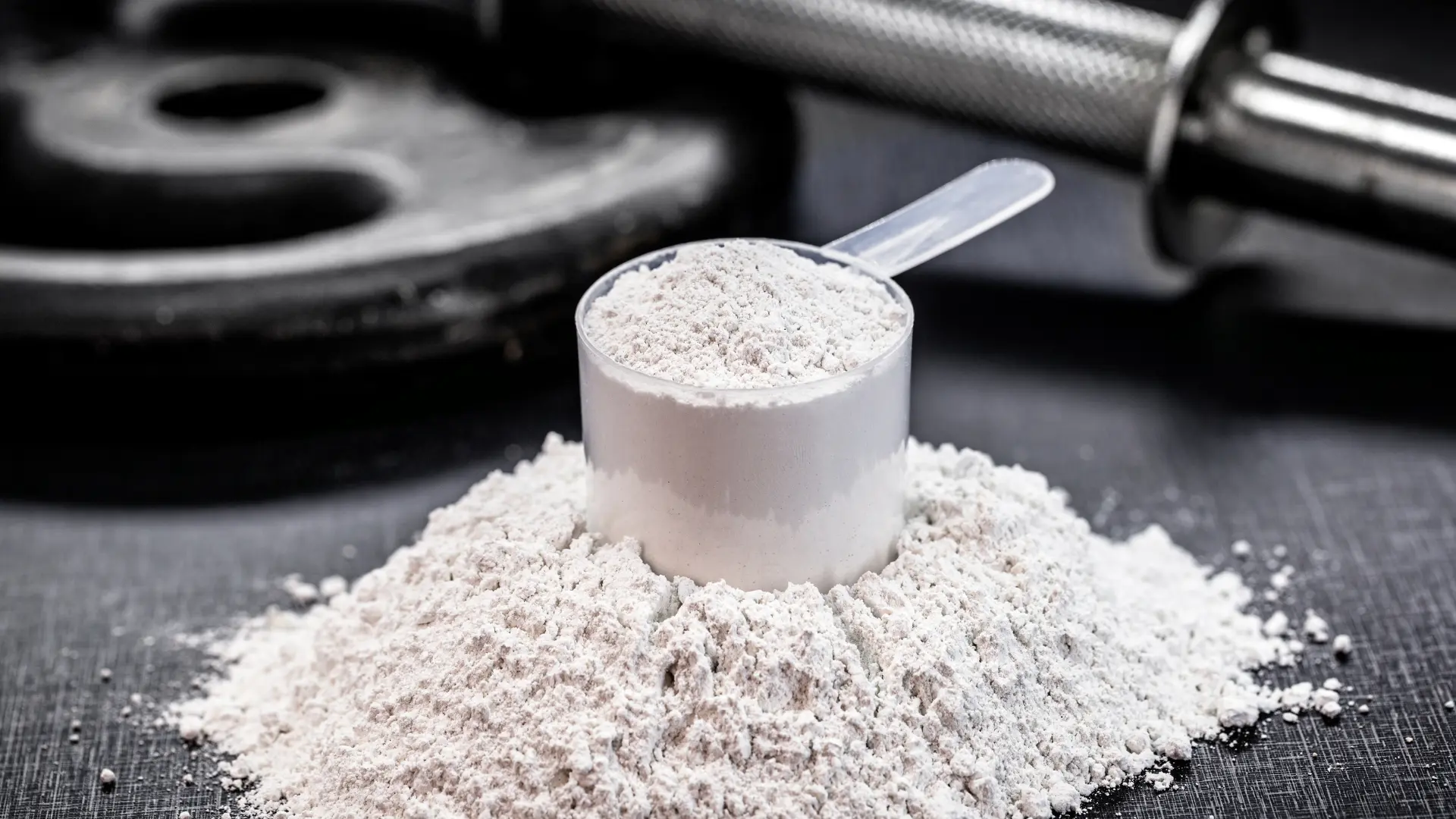
If you train, you have almost certainly heard it: creatine makes your hair fall out. It gets repeated in gym changerooms, comment sections, and forums, and plenty of people have quietly stopped taking one of the best-studied supplements in sports nutrition because of it.
The good news is that this question finally has a direct answer. The less discussed news is that there are real ways a training lifestyle can affect your hair, and they have very little to do with creatine. This guide covers both.
Where the creatine myth came from
The entire concern traces back to a single study published in 2009. Researchers gave 20 college-aged rugby players creatine for three weeks, including a one-week high-dose loading phase, and tracked their hormone levels. During loading, levels of dihydrotestosterone (DHT) rose significantly and stayed above baseline during the lower maintenance dose that followed.[2]
That finding caught attention because DHT is the hormone most closely tied to male pattern hair loss. In people who are genetically predisposed, follicles in certain areas of the scalp are sensitive to DHT, which gradually causes them to shrink and produce finer hair. So the reasoning went: creatine raises DHT, DHT drives hair loss, therefore creatine causes hair loss.
The problem is the step in the middle. The 2009 study never measured hair. It measured a hormone, in a small group, over three weeks. Nobody counted hairs, assessed follicles, or recorded any hair loss at all. The researchers themselves suggested further investigation rather than drawing conclusions about baldness. A plausible mechanism was quietly upgraded into an established fact through years of repetition.
What the newer research shows
In the years since, the hormone finding has not held up well. A 2021 review by the International Society of Sports Nutrition, examining common misconceptions about creatine, concluded that the overall body of evidence does not show creatine increases total testosterone, free testosterone, or DHT, or that it causes hair loss or baldness.[3]
Then in 2025 came the study that should have been done years earlier. A randomised, double-blind, placebo-controlled trial published in the Journal of the International Society of Sports Nutrition gave resistance-trained men either 5 grams of creatine daily or a placebo for 12 weeks. Crucially, the researchers did not stop at blood tests. They assessed the follicles directly, using trichogram testing and the FotoFinder imaging system to measure hair density, follicular unit count, and cumulative hair thickness.[1]
The result: no significant differences between the creatine and placebo groups in DHT levels, in the ratio of DHT to testosterone, or in any of the hair measurements. The authors described it as the first study to directly assess hair follicle health after creatine supplementation, and as strong evidence against the claim that creatine contributes to hair loss.[1]
The honest caveats
Being evidence-led means being clear about what a study does not show, as well as what it does.
The 2025 trial ran for 12 weeks, so it cannot rule out effects over years of use. It enrolled men only, so it tells us less about women. And it excluded people with diagnosed hair loss disorders, which means it does not fully answer the question many people actually care about: whether creatine could speed things up in someone who is already genetically predisposed to pattern hair loss.
That said, there is currently no good evidence that it does. The fair summary is that creatine at standard doses has not been shown to cause hair loss, the best direct evidence points the other way, and the remaining uncertainty is about edge cases rather than typical use. If you are genetically prone to thinning and want to be cautious, that is a reasonable personal choice, but it is caution, not a response to proven risk.
Protein powder: the real risk is what is not on the label
Protein powder attracts similar suspicion, and similarly, there is no good evidence that whey or plant protein causes hair loss. If anything, adequate protein intake supports hair, since hair is built almost entirely from protein, and inadequate protein is a recognised contributor to shedding.
The genuine concern with gym supplements is contamination. Supplements are not regulated like medicines, and testing has repeatedly found products containing ingredients that are not declared on the label. An international analysis of 634 nutritional supplements, bought in 13 countries in 2000 and 2001, found that roughly 15 percent contained undeclared anabolic steroids or prohormones.[4] In a separate investigation in New York, a cluster of people experienced fatigue, muscle aches, and loss of scalp hair, which was traced to vitamin supplements from one supplier that turned out to contain potent androgenic steroids.[5]
That older figure does not mean 15 percent of what is on shelves today is contaminated, and reputable products are generally what they say they are. But it explains why the source of a supplement matters more than the category. Products from obscure online sellers, and anything marketed with aggressive muscle-building or hormone-boosting claims, carry the most risk. Choosing products that carry third-party batch-testing certification, such as Informed Sport, is a simple way to reduce it.
Where the hair loss link is real: steroids, SARMs, and hormone boosters
This is the part of the conversation that matters most, and it is often lost behind the creatine debate.
Anabolic-androgenic steroids do accelerate hair loss in people who are predisposed. They are synthetic versions of testosterone and related hormones, and many convert to DHT or act on the same receptors. For someone carrying the genetics for pattern hair loss, steroid use can bring forward and speed up a process that might otherwise have taken many more years. They also carry well-documented risks to the heart, liver, hormones, and mental health, and in Australia they are prescription-only medicines.
SARMs (selective androgen receptor modulators) are often marketed online as a safer, legal-sounding alternative. They are neither. No SARM has been approved for medical use, products sold as SARMs are frequently mislabelled or contain undeclared substances, and their long-term effects are largely unknown.[7] Hair loss has been reported in people using them, and because standard steroid screening does not detect SARMs, the connection can be easy to miss.[6]
“Testosterone boosters” and prohormones are a grey area. Many contain little that does anything at all. Some, however, contain hormone precursors such as DHEA, which the body can convert into androgens. If a product promises hormonal effects, it is worth asking what is actually producing them.
If you are using or considering any of these and you care about your hair, this is the conversation worth having with a doctor, well before any concern about creatine.
The overlooked culprit: not eating enough
One of the most common gym-related causes of hair shedding has nothing to do with supplements. It is under-eating.
Hair follicles are among the most metabolically active tissues in the body, and when energy or nutrient intake drops sharply, hair growth is one of the first non-essential processes the body scales back. Aggressive cutting phases, rapid weight loss, and very restrictive diets are well-known triggers of telogen effluvium, a form of diffuse shedding that typically appears two to three months after the period of restriction began. Because of that delay, people often blame whatever they started recently, such as a new supplement, rather than the diet that actually caused it. What causes hair loss
Two groups are particularly exposed. People in endurance sports, and women who train heavily, are more likely to run low on iron, which is one of the most common nutritional contributors to shedding. And athletes of any sex who consistently take in less energy than they expend can develop what is known as relative energy deficiency in sport, where low energy availability affects hormones, bone health, and recovery, with hair shedding among the visible signs.
The reassuring part is that shedding from an energy deficit or low iron is usually reversible once the underlying cause is addressed. Identifying it, however, requires looking at your diet and, where appropriate, blood tests, rather than guessing.
Does lifting weights cause hair loss?
No. Resistance training produces short-lived rises in testosterone around a session, but there is no evidence that exercise itself causes or accelerates hair loss. Training is, on balance, good for nearly every system in the body, and there is no reason for anyone to train less out of concern for their hair.
If you notice thinning while you are training
It is worth knowing that the age range when many people get serious about the gym, the late teens through the thirties, is also when male pattern hair loss most commonly starts to become visible. When two things begin around the same time, it is natural to assume one caused the other. Very often, the timing is a coincidence and genetics was always going to show up around then.
The pattern of what you are noticing is the most useful clue. Gradual thinning at the temples, crown, or along the part points towards pattern hair loss. Sudden, diffuse shedding all over the scalp points towards telogen effluvium, so think back two to three months for a crash diet, illness, or major stressor. Either way, the useful next step is identifying the cause rather than cycling supplements on and off. For pattern hair loss in particular, earlier assessment preserves more options, since it is far easier to keep hair than to recover it.
Practical takeaways
- Creatine at standard doses has not been shown to cause hair loss. The best direct evidence found no effect on DHT or on the hair follicles themselves.
- Protein powder is not a hair loss risk in itself, and adequate protein supports healthy hair.
- The source of your supplements matters. Choose reputable brands, and prefer third-party batch-tested products.
- Anabolic steroids, SARMs, and some hormone boosters are where the real hair risk sits, alongside wider health risks.
- Watch your energy intake and iron, particularly during cutting phases, endurance training, or if you are a woman who trains heavily.
- If you notice thinning, look at the pattern and timing before blaming any single product, and get it assessed if it persists.
Frequently asked questions
Does creatine cause hair loss?
The current evidence says no. The concern came from a 2009 study that measured a rise in DHT but never measured hair. A 2025 randomised controlled trial that assessed the hair follicles directly found no difference in DHT or in hair density, follicle count, or thickness between people taking creatine and those taking a placebo.
Should I skip the creatine loading phase to be safe?
The 2009 DHT finding occurred during a high-dose loading phase. There is no evidence that loading causes hair loss, but loading is also not necessary: a standard daily dose reaches the same muscle saturation, just more gradually. If skipping it gives you peace of mind, there is no performance downside beyond the slower start.
If I am genetically prone to hair loss, should I avoid creatine?
There is no good evidence that creatine accelerates genetic hair loss, but the strongest trial to date did not include people with existing hair loss disorders, so this question is not completely settled. If you are concerned, discussing your overall hair loss risk with a clinician is more useful than focusing on creatine alone.
Can protein powder cause hair loss?
Protein itself does not. The realistic risk is a contaminated product containing undeclared hormones, which is why choosing reputable, batch-tested supplements matters.
Will my hair grow back if the shedding was caused by dieting?
Shedding triggered by a calorie deficit, rapid weight loss, or low iron is usually temporary, and hair commonly recovers over several months once intake is restored. Shedding that continues beyond about six months is worth having investigated.
About this article
This article draws on peer-reviewed research and is general information, not medical advice. If you are concerned about hair loss, or about supplements or substances you are using, speak to a qualified health professional.
References
- Lak M, et al. Does creatine cause hair loss? A 12-week randomized controlled trial. Journal of the International Society of Sports Nutrition. 2025;22(sup1):2495229. https://pubmed.ncbi.nlm.nih.gov/40265319/ ↩a ↩b
- van der Merwe J, Brooks NE, Myburgh KH. Three weeks of creatine monohydrate supplementation affects dihydrotestosterone to testosterone ratio in college-aged rugby players. Clinical Journal of Sport Medicine. 2009;19(5):399-404. https://pubmed.ncbi.nlm.nih.gov/19741313/ ↩
- Antonio J, et al. Common questions and misconceptions about creatine supplementation: what does the scientific evidence really show? Journal of the International Society of Sports Nutrition. 2021;18:13. https://pmc.ncbi.nlm.nih.gov/articles/PMC7871530/ ↩
- Geyer H, Parr MK, Mareck U, et al. Analysis of non-hormonal nutritional supplements for anabolic-androgenic steroids: results of an international study. International Journal of Sports Medicine. 2004;25(2):124-129. https://www.thieme-connect.com/products/ejournals/html/10.1055/s-2004-819955 ↩
- Androgenic steroids in over-the-counter dietary supplements: analysis for association with adverse health effects. Steroids. 2023;193:109199. https://pubmed.ncbi.nlm.nih.gov/36796473/ ↩
- Identification of dehydroepiandrosterone-s (DHEA-s) elevation due to performance enhancing supplements. Journal of the Endocrine Society. 2020 (conference abstract). https://pmc.ncbi.nlm.nih.gov/articles/PMC7207409 ↩
- Leaney AE, et al. Analysis of supplements available to UK consumers purporting to contain selective androgen receptor modulators. Drug Testing and Analysis. 2021;13(1):122-127. https://pubmed.ncbi.nlm.nih.gov/32748554/ ↩

 +61 406 888 546
 admin@cosmedhairskin.com.au
 Brisbane Bowen Hills: 10/7 O'Connell Tce, Bowen Hills QLD 4006