
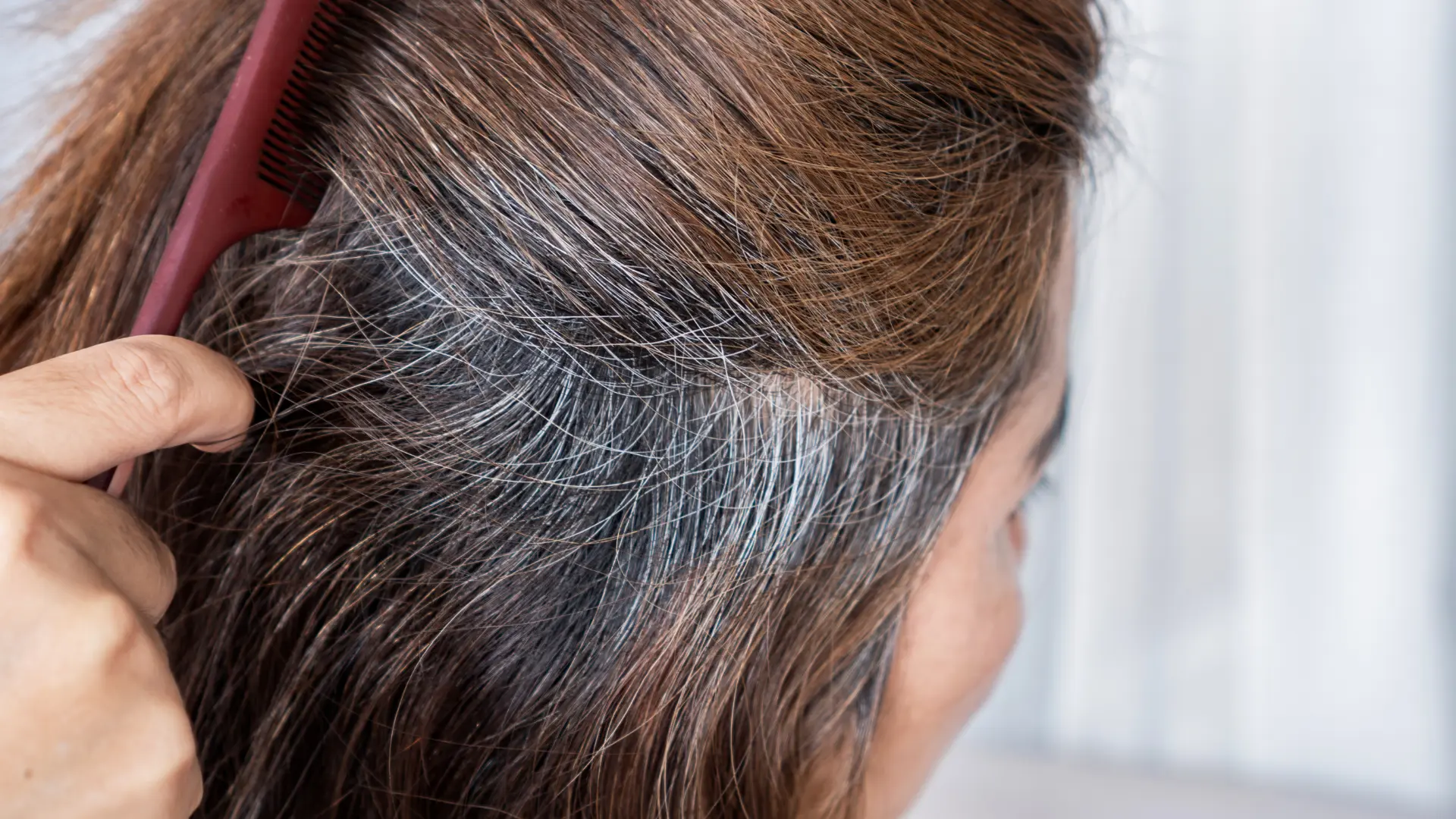
It is one of the first questions people ask when they spot a few greys: is this permanent, or can it be undone? The honest answer is that it depends entirely on why your hair went grey in the first place. Some causes of greying can be slowed, and in certain cases even reversed. Others, at least with the treatments available today, cannot. This guide walks through what the science actually shows, so you can work out which kind you are dealing with and what, realistically, can be done about it.
Why hair goes grey
Your hair colour comes from a pigment called melanin, produced by cells called melanocytes at the base of each hair follicle. These pigment cells are replenished from a small reserve of melanocyte stem cells. Each time a new hair enters its growth phase, some of those stem cells move into position, mature into melanocytes, and load pigment into the strand as it grows.
Greying begins when this process falters. The pigment cells make less melanin, stop working, or are not replaced. What we see as grey is really a mix of pigmented and unpigmented strands, and once a follicle produces no melanin at all, that individual hair grows in white. The hair shaft itself is otherwise normal, which is a useful clue: greying is a pigment problem, not a sign the hair is unhealthy.
When does greying normally start?
Greying is mostly written into your genes. Family history is the strongest predictor of when it will happen, which is why it often follows a similar timeline to your parents. On average, people of European descent tend to notice their first greys in their mid-thirties, those of Asian descent a little later, and those of African descent later still, though individual variation is wide.
Dermatologists use the term premature greying, or premature canities, when it starts noticeably earlier than expected for someone’s background. The commonly used thresholds are before around age 20 in people of European descent, before 25 in those of Asian descent, and before 30 in those of African descent. Greying within the normal age range is simply ageing. Greying well before it is where it is worth asking whether something else is contributing, because that is the situation most likely to involve a reversible factor.
The honest answer: it depends on the cause
Whether greying can be reversed comes down to one question. Are the pigment cells still there and simply underperforming, or are they gone? When they are merely underperforming because of a specific trigger, removing that trigger can sometimes restore colour. When they are depleted, as happens with age, colour does not come back.
Greying that can sometimes be reversed
This kind is usually premature greying linked to an identifiable cause. Addressing the cause can, in some documented cases, allow pigment to return. The factors with real evidence behind them:
Nutritional deficiencies. This is the best-studied reversible cause. Low vitamin B12 is the most consistently linked, and there are documented cases of hair darkening after a genuine B12 deficiency was corrected. Low iron stores (measured as ferritin), low vitamin D, and low copper have also been associated with premature greying across several studies. It is worth being precise about the strength of this evidence: these are associations together with individual case reports, not large proven trials, and correcting a deficiency helps only where a real deficiency exists. Taking supplements you do not need will not restore colour and carries its own risks.
Thyroid and other medical conditions. Thyroid dysfunction, particularly an underactive thyroid, has repeatedly been associated with early greying, and treating the underlying condition may help. Some autoimmune conditions also affect pigment. Vitiligo, for instance, destroys pigment cells in patches, and hair regrowing after an episode of the hair-loss condition alopecia areata can initially come in white.
Significant stress. For a long time the stress-and-grey-hair link was dismissed as folklore. Then in 2021, a Columbia University team published the first quantitative human evidence in the journal eLife. By mapping colour changes along individual hair strands and matching them to people’s stress diaries, they showed not only that periods of stress lined up with greying, but that some greyed hairs regained their colour when the stressful period passed. In one striking case, a strand repigmented during a two-week holiday. The researchers were careful about what this means: they proposed that hair sits near a greying threshold as we age, and stress can tip it over, so easing stress may let a recently greyed hair near that threshold recover. It does not mean reducing stress will re-colour hair that has been grey for years.
Smoking and oxidative stress. Smoking is consistently associated with earlier greying, thought to relate to oxidative damage to the pigment-producing cells. Stopping will not reverse established greying, but it removes one accelerating factor.
Greying that cannot yet be reversed
Most greying is simply part of growing older, and this kind is currently considered permanent. With age, the reserve of melanocyte stem cells that maintains colour gradually runs down. Research indicates that once those stem cells are exhausted, the follicle loses the ability to produce pigment for good, and no proven treatment restores it. Age-related and strongly genetic greying belong here. This is the honest limit of current medicine: any product or service that promises to reverse ordinary age-related grey is claiming more than the evidence supports.
What the latest research shows
Grey hair is an active research field, and some of the recent work is genuinely promising. In 2023, researchers at NYU Langone Health, publishing in Nature, showed that in mice the pigment stem cells can become physically stuck in one compartment of the follicle. Stranded there, they miss the chemical signals that would prompt them to mature into pigment producers, so the hair grows without colour. The team suggested that if this mobility could be restored, it might one day offer a route to reversing or preventing greying. Repigmentation has also been documented as an incidental side effect in some patients treated with certain immunotherapy drugs for unrelated conditions.
These are important findings, but they need honest framing. They are early-stage, carried out largely in mice or observed by chance in patients being treated for something else. They point to mechanisms and possibilities, not to a treatment you can book today. It is reasonable to feel optimistic about the direction of travel while being clear that a proven, targeted therapy to reverse age-related grey hair does not currently exist.
Common myths about grey hair
A few widely repeated beliefs are worth clearing up, because they shape how people react to their first greys.
“Pluck one grey and more will grow back.” This is a myth. Each follicle grows only one hair, so plucking a grey does not cause neighbouring follicles to turn grey or multiply. What plucking can do is irritate or damage the follicle over time, so it is a habit worth avoiding, though not for the reason people usually give.
“Stress turned my hair grey overnight.” Hair that has already grown out of the scalp cannot change colour, so true overnight greying does not happen. What stress can do, as the Columbia research showed, is speed up greying in hairs that are still growing. Dramatic “sudden” cases usually reflect other processes, such as rapid hair loss that leaves existing white hairs more visible.
“Grey hair means poor health.” For most people, greying is a normal, genetically timed part of ageing and says nothing about their health. It is only when greying is notably premature that it is worth checking for the specific, sometimes treatable factors described above.
What genuinely helps right now
If your aim is to protect the colour you have and rule out anything reversible, a measured approach makes sense:
Investigate the cause, especially if greying started early or suddenly. Rather than guessing, this is where objective information helps. Clinicians looking into premature greying typically consider a blood panel covering markers such as vitamin B12, folate, ferritin, vitamin D, and thyroid function, to see whether a treatable deficiency or condition is contributing.
Address what is genuinely found. If a real deficiency or thyroid issue turns up, correcting it under proper guidance is worthwhile for your overall health and may help your hair. If nothing treatable is found, that is useful to know too, because it saves you spending on products that cannot help.
Support your general scalp and hair health. A healthy scalp environment supports the follicles you have. Managing stress and not smoking are sensible for many reasons, with greying among the smaller ones.
Be sceptical of bold promises. Any product or clinic promising to reverse age-related grey hair is offering more than the science currently supports. Trustworthy advice will always separate premature, potentially reversible greying from the ordinary greying of age.
Remember that colour is a perfectly good choice. For age-related greying, cosmetic colour remains the reliable option, and many people choose to embrace their grey entirely. Neither is wrong.
When it is worth getting checked
If your hair started greying young, or changed noticeably over a short period, a professional assessment can help you understand what is going on rather than leaving it to guesswork. A scalp and hair assessment, ideally alongside your GP for any relevant blood tests, can help identify whether a reversible factor is present and worth addressing. If it is not, you will at least have a clear answer and can make your next decision with confidence.
The bottom line
Grey hair can sometimes be reversed when it is driven by something specific and treatable, such as a nutritional deficiency, a thyroid condition, or a period of significant stress, and usually when the greying is premature rather than age-related. The gradual greying of ageing is a different matter: for now it cannot be reliably reversed, though research into the underlying stem cells is moving in encouraging directions. The most useful first step is not chasing a cure but understanding why your hair is greying, because that is what tells you whether anything can, or needs to, be done.






 +61 406 888 546
 admin@cosmedhairskin.com.au
 Brisbane Bowen Hills: 10/7 O'Connell Tce, Bowen Hills QLD 4006