

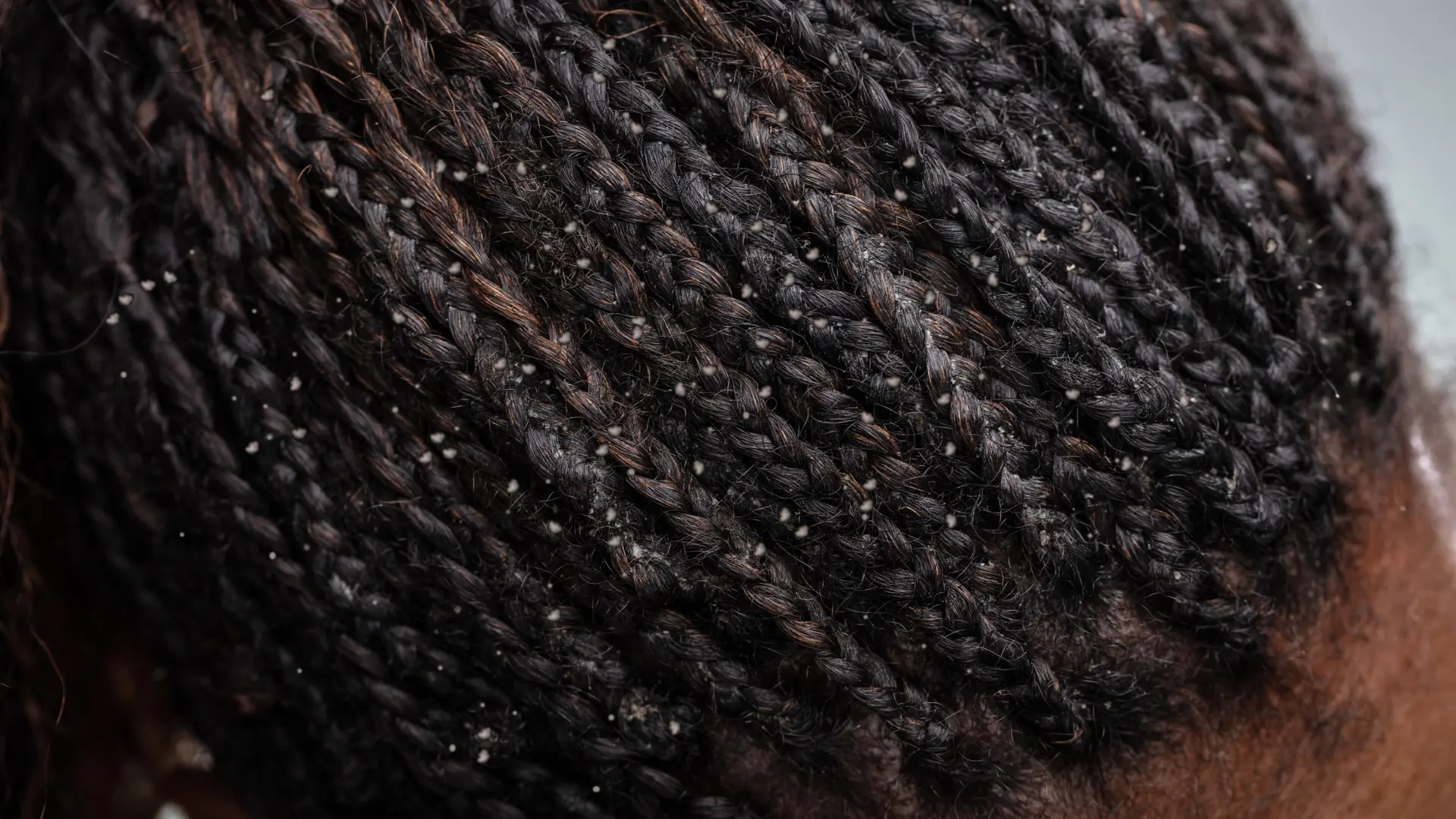
If you have flakes on your shoulders and more hair in the shower drain, it is natural to wonder whether the two are connected. It is one of the most common questions people ask about their scalp, and the answers online swing between "dandruff makes you bald" and "there is no link at all".
The evidence sits somewhere in between. Dandruff on its own does not cause hair loss. But a scalp that is inflamed, itchy and constantly scratched is not a neutral bystander either. This guide explains what dandruff actually is, what the research shows about its effect on hair, and how to tell when flaking is a sign of something that needs a doctor.
Dandruff and seborrhoeic dermatitis: the same condition at different strengths
Dandruff is flaking of the scalp skin. It is extremely common. Healthdirect, the Australian Government's health information service, notes that most people have it at some point.[1]
Seborrhoeic dermatitis is the more inflamed version of the same process. The Australasian College of Dermatologists describes it as inflammation of the skin in areas with more oil glands, producing greasy white or yellowish scales over red skin, and notes that mild cases on the scalp are usually just called dandruff.[3] It can also affect the eyebrows, the sides of the nose, the ears and the chest. A 2024 analysis of 121 studies covering more than 1.2 million people estimated that seborrhoeic dermatitis affects about 4.4 percent of people worldwide, and about 5.6 percent of adults.[4]
The cause is not fully understood. The leading explanation is an immune reaction to Malassezia, a yeast that lives on everyone's skin and is found in greater numbers in oily areas. Why some people react to it and others do not is unclear.[2][3]
Three things are worth knowing because they are widely misunderstood:
- It is not caused by poor hygiene.[1][2]
- It is not contagious.[1][2]
- It tends to come and go. In adults it is usually a long-term condition that flares and settles, and most people need some form of regular or occasional treatment to keep it under control.[2][3]
Flares have triggers. Stress, illness, hormonal changes and seasonal changes can all make dandruff worse, and dermatologists also list sweating, heat and sun among the things that can set off seborrhoeic dermatitis.[1][10] That last group is worth remembering through a Queensland summer.
Does dandruff cause hair loss?
The direct answer, from Healthdirect: dandruff does not cause hair loss or serious problems.[1]
That is the right starting point, and it should take some worry off the table. Flakes are not a sign that your follicles are failing, and having dandruff does not mean you are going bald.
The fuller picture has a little more to it, because there are three ways a troubled scalp and thinning hair can turn up together.
What the research shows
Treating dandruff has been shown to reduce shedding in one specific group. In a study of 150 men who had both dandruff and increased shedding linked to pattern hair loss, participants used one of three medicated anti-dandruff shampoos two to three times a week for six months. Hair shedding fell by 17.3 percent, 16.5 percent and 10.1 percent across the three groups, and the proportion of hairs in the active growth phase rose slightly.[5]
Two limits on that finding matter. Hair density on the crown was unchanged at the end of the study, so the shampoos reduced how much hair was being shed without making hair thicker. And all three groups used a medicated shampoo, so there was no comparison against an ordinary one. The fair reading is that calming the scalp can reduce excess shedding. It is not evidence that anti-dandruff shampoo regrows hair.
There is also a broader argument that scalp health affects the hair growing out of it. A 2018 review in the International Journal of Trichology argued that the scalp acts as an incubator for the hair before it emerges, and that scalp conditions such as dandruff and seborrhoeic dermatitis may contribute to premature hair loss through oxidative stress.[6] It is a plausible idea, but it should be read with two cautions. The review rests largely on observational data rather than controlled trials, and two of its four authors were employed by a company that manufactures anti-dandruff shampoo. We mention it because it is frequently cited, not because it settles the question.
Taken together: there is reasonable evidence that an inflamed scalp can add to shedding, and that treating it helps. There is no good evidence that dandruff alone causes lasting hair loss.
The more common culprit: scratching and picking
The clearest route from a flaky scalp to lost hair is mechanical. An itchy scalp gets scratched, and thick scale gets picked.
The American Academy of Dermatology spells this out in its advice on scalp psoriasis, a different condition that also causes scale and itch. Removing scale forcefully can pull hair out with it, scratching can loosen hair, and a dry scalp makes hair more likely to break. Its advice is to loosen scale gently, avoid picking, and keep fingernails short and smooth. The reassuring part is that hair tends to regrow once the scalp condition clears.[7]
That guidance was written for psoriasis, but the mechanics of fingernails on an irritated scalp are the same whatever is causing the itch. If you catch yourself scratching through the day, treating the itch is doing your hair a favour.
Two common things can simply happen together
Dandruff is very common, and so is pattern hair loss. Plenty of people have both, with neither causing the other.
This matters because it is easy to spend months treating flakes while genetic thinning quietly continues. If your hair is thinning in a pattern, at the temples and crown in men or along the part line in women, clearing your dandruff will make your scalp more comfortable but will not address the thinning. That needs to be assessed in its own right. What causes hair loss
When it is not just dandruff
Not all flaking is dandruff, and some look-alikes do cause hair loss or need medical treatment. Dermatologists point to several conditions worth knowing about.[8]
Scalp psoriasis. Psoriasis causes skin cells to grow too quickly, producing well-defined reddish plaques with silvery scale, often with itching or burning. It can cause temporary hair loss.[8]
Tinea capitis (scalp ringworm). This is a fungal infection of the scalp that spreads through contact. It causes scaly patches, hair loss or broken hairs, and needs prescription treatment from a doctor.[8]
Sun damage. Actinic keratoses are dry, rough, scaly patches caused by years of sun exposure. They can feel like sandpaper, are often not itchy or painful, and some can develop into skin cancer if left untreated.[8] This one deserves particular attention in Queensland, and especially if your hair is thinning, because a scalp with less hair cover gets more sun. A rough or scaly spot on your scalp that does not go away should be checked by a GP or dermatologist rather than treated as dandruff.
How to manage dandruff properly
The basics are well established, and how you use the shampoo matters as much as which one you buy.
- Choose the right active ingredient. Anti-dandruff shampoos work through ingredients such as zinc pyrithione, selenium sulfide, ketoconazole, ciclopirox, salicylic acid and coal tar.[1][9] A pharmacist can help you choose.
- Give it contact time. Some shampoos need to sit on the scalp for 5 to 10 minutes before rinsing. Lather it into the scalp and follow the directions on the bottle.[9]
- Match the frequency to your hair. For fine or straight hair, or an oily scalp, dermatologists suggest washing often and using the dandruff shampoo about twice a week. For coarse, curly or coily hair, about once a week, applied to the scalp only, since the ingredients can dry the hair.[9]
- Switch if it stops working. If one shampoo is not helping, alternate with one that has a different active ingredient.[1][9]
- Go easy on drying habits. Healthdirect advises avoiding oily hair products, products containing alcohol, and frequent use of hair dryers and straighteners.[1]
- Protect your scalp from the sun. Sunburn on the scalp can increase flaking, and coal tar shampoos can make the scalp more sensitive to UV. A wide-brimmed hat is the simplest protection, with sunscreen on any exposed scalp if your hair is thinning.[9]
- Expect it to come back. Dandruff can be controlled but often returns, so occasional maintenance use is normal rather than a sign of failure.[1]
If you want to understand what is on the back of the bottle, our ingredient guide covers it in more detail. Shampoo ingredients guide
When to see a doctor
Healthdirect advises seeing a doctor if you have:[1]
- dandruff that is not improving, or is affecting your daily life
- very large flakes
- flaking or irritation in other areas, such as the face
- a painful, red, swollen or bleeding scalp
- patches of hair loss
Patchy hair loss, in particular, is not something dandruff causes, and it should be looked at promptly.
Where a scalp assessment fits
If you are dealing with both a troublesome scalp and hair that seems thinner, the useful step is working out which problem is which. A scalp and hair assessment can look at the condition of your scalp and the pattern of your hair together, identify whether there is thinning that needs attention in its own right, and point you to a GP or dermatologist when something looks like it needs a medical diagnosis.
Looking after your scalp is worthwhile for its own sake. Just make sure the flakes are not distracting you from the bigger question.
Frequently asked questions
Does dandruff cause hair loss?
Not directly. Australian Government health guidance states that dandruff does not cause hair loss. An inflamed, itchy scalp can add to shedding, scratching can loosen or break hair, and one study found that treating dandruff reduced shedding in men who also had pattern hair loss.
Will anti-dandruff shampoo regrow my hair?
No. In the main study on this, medicated shampoos reduced hair shedding over six months, but hair density did not change. They can calm the scalp and reduce excess shedding, which is useful, but they are not a hair regrowth treatment.
Is dandruff caused by not washing enough?
No. Dandruff is not caused by poor hygiene and it is not contagious. It is linked to how an individual's skin reacts to a yeast that lives on everyone's scalp.
What is the difference between dandruff and seborrhoeic dermatitis?
They are the same underlying condition at different strengths. Mild flaking on the scalp is usually called dandruff. When the skin is also red and inflamed, with greasy scale, or other areas such as the face are involved, it is called seborrhoeic dermatitis.
Why does my dandruff keep coming back?
Because in adults it is usually a long-term condition that flares and settles. Stress, illness, seasonal changes, heat and sweating can all trigger it. Most people need occasional maintenance treatment to keep it controlled.
When should I worry about a flaky scalp?
See a doctor if it is not improving with anti-dandruff shampoo, if your scalp is painful, swollen or bleeding, if you have patches of hair loss, or if you have a rough, scaly spot that does not go away.
About this article
This article draws on Australian Government health information, guidance from the Australasian College of Dermatologists and the American Academy of Dermatology, and peer-reviewed research. It is general information, not medical advice. If you are concerned about your scalp or about hair loss, speak to a qualified health professional.
References
Numbers in square brackets in the article refer to the sources below. Select a number to jump here, and the return arrow to jump back.
- Healthdirect Australia. Dandruff. Last reviewed April 2025. https://www.healthdirect.gov.au/conditions/hair-problems/dandruff ↩a ↩b ↩c ↩d ↩e ↩f ↩g ↩h ↩i ↩j
- Healthdirect Australia. Seborrhoeic dermatitis. Last reviewed December 2023. https://www.healthdirect.gov.au/seborrhoeic-dermatitis ↩a ↩b ↩c ↩d
- Aspres N. Seborrhoeic dermatitis and cradle cap. A-Z of Skin, Australasian College of Dermatologists. 2019. https://www.dermcoll.edu.au/atoz/seborrhoeic-dermatitis-cradle-cap/ ↩a ↩b ↩c
- Polaskey MT, Chang CH, Daftary K, Fakhraie S, Miller CH, Chovatiya R. The global prevalence of seborrheic dermatitis: a systematic review and meta-analysis. JAMA Dermatology. 2024;160(8):846-855. https://jamanetwork.com/journals/jamadermatology/fullarticle/2820685 ↩
- Franchimont C, Goffin V, Henry F, Uhoda I, Braham C, Pierard G. Nudging hair shedding by antidandruff shampoos. A comparison of 1% ketoconazole, 1% piroctone olamine and 1% zinc pyrithione formulations. International Journal of Cosmetic Science. 2002;24(5):249-256. https://orbi.uliege.be/handle/2268/11902 ↩
- Trüeb RM, Henry JP, Davis MG, Schwartz JR. Scalp condition impacts hair growth and retention via oxidative stress. International Journal of Trichology. 2018. doi:10.4103/ijt.ijt_57_18. https://sonar.ch/global/documents/5112 ↩
- American Academy of Dermatology. Scalp psoriasis: 10 ways to reduce hair loss. https://www.aad.org/public/diseases/psoriasis/treatment/genitals/scalp-hair-loss ↩
- American Academy of Dermatology. Is your dry scalp something more serious? Last updated May 2021. https://www.aad.org/public/everyday-care/hair-scalp-care/scalp/dry-scalp-conditions ↩a ↩b ↩c ↩d
- American Academy of Dermatology. How to treat dandruff. Last updated December 2023. https://www.aad.org/public/diseases/hair-and-scalp-problems/dandruff-how-to-treat ↩a ↩b ↩c ↩d ↩e
- American Academy of Dermatology. Seborrheic dermatitis: self-care. Last updated December 2022. https://www.aad.org/public/diseases/a-z/seborrheic-dermatitis-self-care ↩


 +61 406 888 546
 admin@cosmedhairskin.com.au
 Brisbane Bowen Hills: 10/7 O'Connell Tce, Bowen Hills QLD 4006