TL;DR
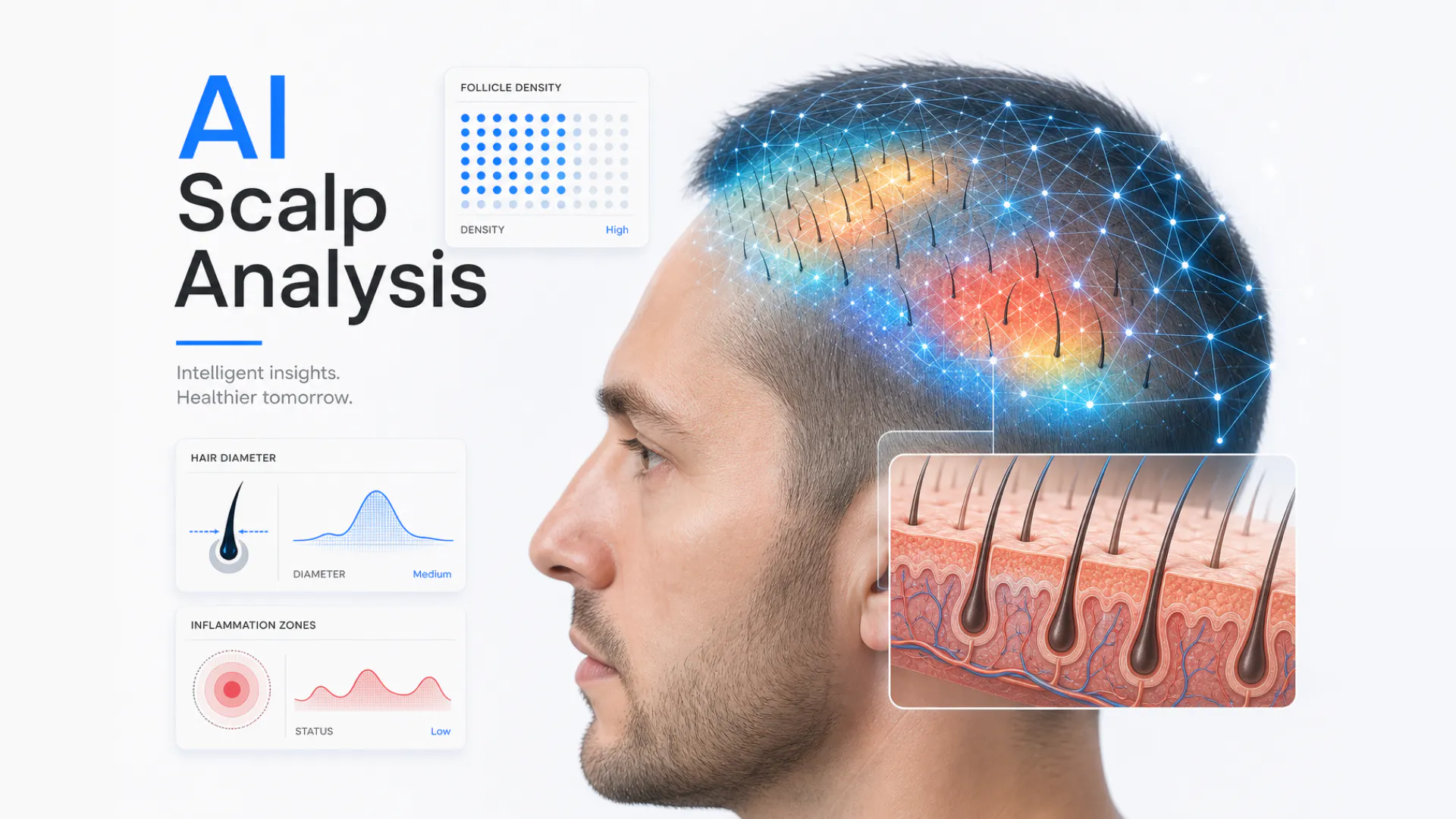
AI scalp analysis uses machine learning to detect follicle density, inflammation, sebum balance, and scalp health metrics invisible to the naked eye. It reveals what is happening at your scalp-but not why. This diagnostic data, interpreted by a trained professional, guides personalised treatment for hair loss and scalp conditions. Unlike traditional guesswork, AI-informed diagnosis reduces bias and enables tracking over time, making it a valuable first step in understanding hair thinning before investing in treatment.
The problem with guessing
When you notice your hair thinning or shedding more, the instinct is usually the same: look in the mirror. Check the part. Count the hairs on your pillow. What you’re doing is visual assessment, and it’s limited. A dermatologist or trichologist can do better-they’ve seen thousands of scalps-but even trained eyes have a ceiling.
At our clinics in MacGregor, Bowen Hills, and Southport, we moved away from the “look and see” method because we wanted something more precise. What does your naked eye miss? Follicle density beneath the surface. The depth of inflammation. Sebum saturation that’s trapping hair in the follicle. The ratio of active (terminal) to dormant (vellus) hairs. The exact pattern of miniaturisation-the hallmark of androgenetic alopecia (genetic hair loss).
These aren’t small details. They’re the difference between understanding your scalp state and guessing.
How AI scalp analysis works
AI scalp analysis is less mysterious than the name suggests. Here’s the actual workflow:
1. Capture: A high-resolution camera (or your clinic’s scalp imaging device) captures detailed photos of your scalp. Unlike a phone photo, these are magnified and consistent-taken at the same angle, lighting, and distance every time.
2. Process: The images are uploaded to a machine learning model-usually a convolutional neural network (CNN) or advanced image classifier-trained on thousands of annotated scalp images. The model has learned to detect patterns: what healthy follicles look like, what inflamed ones look like, how sebum appears, where hair density is thick vs. thin.
3. Measure: The AI quantifies objective metrics:
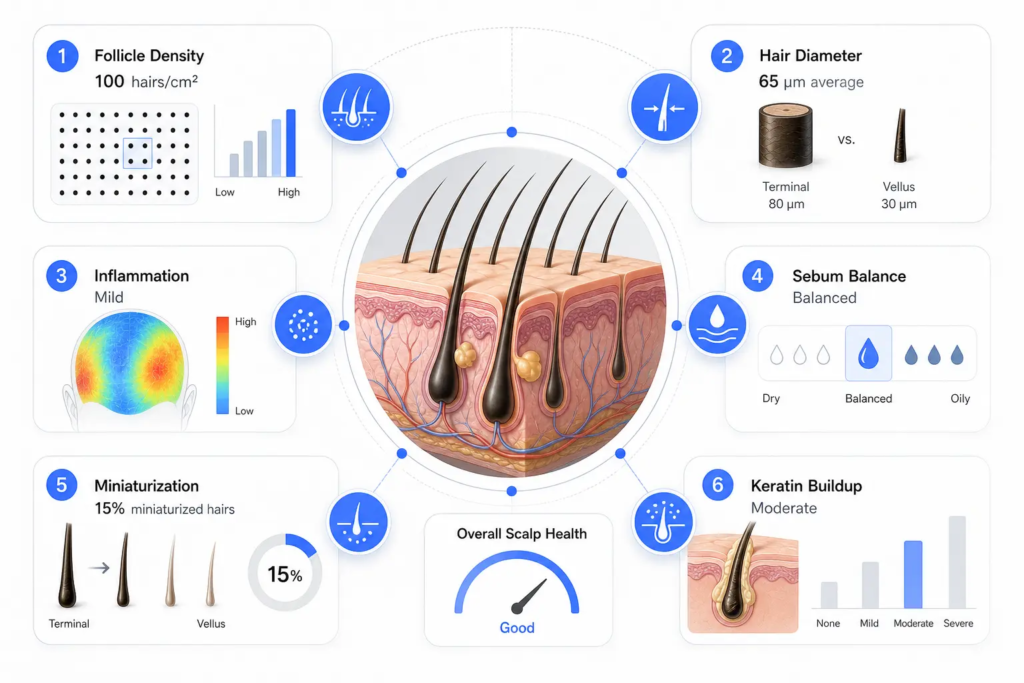
- Follicle density: How many hairs per square centimetre in different scalp zones
- Hair diameter: Thickness of individual shafts (thin shafts = miniaturisation)
- Terminal-to-vellus ratio: Proportion of full-size hairs vs. fine, short hairs
- Scalp surface condition: Redness (inflammation), flaking, dryness, sebum shine
- Distribution pattern: Where thinning is concentrated (crown, front hairline, temples, diffuse)
4. Output: You get a report with visual heat maps, trend lines, and numerical scores. The scales are meaningful: a follicle density of 100 hairs/cm² is normal; 60 hairs/cm² suggests noticeable thinning; 40 hairs/cm² indicates significant miniaturisation.
The key insight: all of this is measured, not guessed. There’s no “I think your hair looks thin.” There’s a number. A percentage change from three months ago. Objective data.
What AI scalp analysis reveals about hair loss
Hair loss looks the same on the surface-thinner strands, wider parts, less fullness-but the scalp state underneath is often completely different. This is where AI diagnosis becomes powerful.
Follicle density loss
The most obvious finding. If your density has dropped from 150 to 90 hairs/cm² in the frontal zone, you have measurable thinning. The scan shows where it’s worst, which helps guide where to focus treatment.
Miniaturisation
As hair loss progresses, follicles don’t die; they shrink. Terminal hairs (thick, pigmented, long-growing) miniaturise into vellus hairs (thin, short, barely visible). AI measures this shift by calculating the terminal-to-vellus ratio. A high ratio of vellus hairs is a red flag for androgenetic alopecia (genetic hair loss) and indicates the window for intervention is narrowing.
Scalp inflammation
A healthy scalp is the foundation for healthy hair-think of it as soil. Inflammation beneath the surface, invisible to your eye, can accelerate follicle miniaturisation. AI detects redness, irritation, and inflammatory markers. When inflammation is high, the first step isn’t always growth stimulation; it’s calming the scalp environment.
Sebum and moisture balance
Oily scalps trap hair in follicles with excess DHT and yeast overgrowth. Dry scalps develop microfissures that trigger chronic low-grade inflammation. Combination scalps-oily on the surface, dehydrated underneath-are common and invisible to the eye. AI heat maps reveal exactly where sebum is concentrated and where hydration is lacking, enabling targeted treatment.
Keratin buildup and follicle clogging
Dead skin cells, sebum, and keratin can clog follicles, preventing new hair from emerging. AI can detect this buildup. If it’s present, a cleansing or exfoliating approach may be the first step, not growth stimulation.
Pattern and distribution
Where is thinning concentrated? Crown loss suggests androgenetic alopecia. Diffuse thinning across the scalp suggests telogen effluvium (stress-related shedding) or nutritional deficiency. Frontal thinning in women might suggest female pattern hair loss or traction alopecia. The pattern, combined with density maps, helps a clinician narrow down the cause.
What AI scalp analysis cannot do
Before you book your scan, it’s crucial to understand the limits.
AI cannot diagnose the cause of hair loss. The scan reveals scalp state (density, inflammation, sebum, miniaturisation). It does not tell you whether your hair loss is genetic, hormonal, nutritional, stress-related, autoimmune, or medical. Cause diagnosis requires clinical history, blood work sometimes, and professional interpretation.
AI cannot predict treatment response. Knowing your follicle density doesn’t predict how you’ll respond to PRP, PRF, minoxidil, or finasteride. Response depends on follicle viability (are they dormant or dead?), cause, genetics, and other factors the scan doesn’t measure.
AI cannot assess systemic health. Hair loss is often a symptom of something deeper-thyroid dysfunction, iron deficiency, hormonal imbalance, stress, or medical conditions. A scalp scan doesn’t replace blood work or a full medical assessment.
AI cannot guarantee accuracy across all skin tones. Most AI models are trained on lighter skin tones, and studies show reduced accuracy on darker skin. A good clinic is aware of this limitation and interprets results with caution for all patients.
AI cannot replace clinical judgment. The best clinics use AI as a diagnostic support tool, not a replacement for expertise. A trained trichologist or dermatologist sees the data, asks about your history, and makes an informed recommendation. The data is powerful, but it’s not the full picture.
The diagnosis-first approach
This is where AI scalp analysis earns its place in modern hair loss treatment.
Traditional hair loss clinics often work backward: you describe your problem, they recommend a package (PRP + LED + home care), and you hope it works. The approach is standardised. The risk is over-treating or under-treating.
AI-first clinics work forward: scan first, diagnose the scalp state, then recommend treatment. If inflammation is the primary finding, anti-inflammatory treatment comes first. If miniaturisation is advanced, regenerative therapies (PRP/PRF) might combine with regrowth support. If sebum clogging is the issue, scalp cleansing is step one.
This isn’t just more scientific-it’s more respectful of your time and money. You’re not paying for a standard kit; you’re paying for a diagnosis and a plan tailored to your scalp.
How Cosmed uses AI scalp analysis
Our AI scalp analysis process starts with a free consultation and scan. The scan takes minutes. You get a detailed report showing your follicle density map, inflammation zones, sebum balance, and miniaturisation profile. Then our team-trained trichologists and doctors-interprets the data, discusses your goals, and builds a personalised roadmap.
That roadmap might include PRP or PRF to support scalp healing, scalp treatments for specific conditions (dandruff, seborrhoeic dermatitis, psoriasis), LED therapy for circulation, and home care to maintain results. The specifics depend entirely on what the scan and your consultation reveal.
Critically: you’re not locked into a three-month package sight unseen. You understand your scalp state before committing to treatment. You can ask questions. You have data.
Why early diagnosis matters
Hair loss is one of the few conditions where early intervention is genuinely powerful. Follicles can miniaturise and eventually stop producing visible hairs. But they often don’t die outright-they go dormant. If caught early, regenerative treatments can sometimes wake them back up.
But if you wait two years, hoping your hair stops shedding on its own, those follicles may progress further. The window for intervention narrows.
AI scalp analysis accelerates that diagnosis. Instead of guessing (“my hair looks thinner, maybe it’ll stop?”), you have data. Follicle density at month zero. If it’s declining, you know early. You can act.
For men noticing early receding or thinning and women with increasing shedding or widening parts, this is powerful. You’re not reacting to visible baldness; you’re responding to early, measurable changes in scalp state.
The bottom line
AI scalp analysis is not a cure. It’s not a magic diagnostic that tells you everything. It’s a tool that does one thing very well: measures your scalp state objectively, removing guesswork and bias from the diagnosis process.
What it reveals-follicle density, inflammation, sebum balance, miniaturisation patterns-directly informs treatment. And treatment informed by diagnosis is far more likely to succeed than treatment based on assumption.
If you’re noticing hair shedding, a widening part, or thinner ponytail, the first step isn’t buying a product. It’s understanding what’s actually happening at your scalp. That’s what AI diagnosis is for.
Ready to understand your scalp?
Cosmed HairSkin Solutions offers a free AI scalp analysis and consultation at our clinics in MacGregor (Brisbane), Bowen Hills (Brisbane), and Southport (Gold Coast). No obligation. No referral needed. Just data and expert interpretation.
Book your free scalp analysis and get a personalised treatment roadmap based on what your scalp actually needs-not what we guess it needs.



 +61 406 888 546
 admin@cosmedhairskin.com.au
 Brisbane Bowen Hills: 10/7 O'Connell Tce, Bowen Hills QLD 4006